Showing posts with label 2012. Show all posts

Tuesday, April 2, 2013

Truncated Runtime Hurts 'The Sessions'


One of the best aspects of The Sessions, is the frank approach it takes
to the sex scenes between Helen Hunt and John Hawkes.
Oddly enough, the best compliment and biggest criticism I have for The Sessions are one in the same – it left me wanting more.

The film is based on the true-life sexual awakening of Mark O’Brien (John Hawkes),* a freelance writer and poet unable to move any muscles below his neck and forced to spend most of his days in an iron lung due to contracting Polio at a young age. At 38-years old, Mark realizes he is approaching his sell-by date and so, after getting the blessing of his open-minded priest Father Brendan (William H. Macy), he hires a sex surrogate named Cheryl (Helen Hunt) to help him achieve sexual penetration.

*I had never heard of O’Brien until this movie, but he was the focus of an Oscar Winning documentary (Breathing Lessons: The Life and Work of Mark O’Brien). Furthermore, The Sessions is an adaptation of an article he wrote entitled ‘On Seeing a Sex Surrogate,’ a quick read that fills in many of the particulars on sex surrogacy. For those who are interested, the documentary can be found here, and the article is posted here.
In their first meeting, Cheryl clearly establishes parameters of what is and isn’t going to happen. Mark is paying her to have sex, but she is not a prostitute. That means she doesn’t need the money up front or in cash, and she’s not interested in his return business. To avoid intimacy, she refuses to share personal information and adheres to a six session limit. However, things don’t go as planned, and eventually a connection is forged.

This is the material of a great story, but unfortunately the movie doesn’t fully deliver. The big problem is the abbreviated run-time. Even with credits, the film runs a scant 91 minutes, and, as a result, the conclusion is abrupt, many subplots are left hanging, and a multitude of interesting corners are left unexplored.

Outside of Mark’s personal journey, nearly everything seems rushed and unfinished. It’s a shame really, because every actor in this thing seems plugged in, even peripheral ones like Adam Arkin (as Cheryl’s husband) and Moon Bloodgood (as Mark’s aid).
Obviously that’s a positive, but it also raises the bar, which, given the ultimate scope of the piece, is not a good thing.

Take the Bloodgood character for instance. She’s given two or three scenes with an employee at the hotel where Mark and Cheryl conduct their sessions. They have chemistry, he seems interested, she seems to be playing hard to get, but then it goes nowhere, and you’re left wondering, “What was the point of this subplot?”

William H. Macy is good as an interactive plot device.

And then there’s Father Brendan. Macy brings a great deal of warmth to the part, and he gets one of the best lines in the movie (“I know in my heart that God will give you a free pass on this one”). However, beyond the scene built around that line, we don’t get much in the way of his moral conflict. He’s just a buddy Mark tells all his lewd behavior too – or, more cynically, a plot device that allows the film to eschew voice over narration. The idea that Mark plans to write about the issue does not seem to faze Father Brendan, even though it would surely raise eyebrows among his higher-ups and congregation.

But Cheryl’s development poses the biggest issue. We get hints of maternal issues (her son calls her Cheryl) and marital problems (her husband wants her to convert to Judaism) that just go nowhere, and we’re asked to believe that a woman who has sex for a living and has gone through this process many times, would fall for this guy. He writes a poem sure, but is that all it takes? More scenes would’ve been helpful to contextualize everything, particularly one showing her with another patient.**

**In an interview with the Huffington Post, Cheryl Cohen Green, Mark’s real life surrogate, indicated they did not fall in love as the film suggests. For the record, Mark’s article never implied they did. Given the lack of tangible development, this isn’t exactly surprising. Having said that, I do believe it was a good idea to alter the story for the movie; I just don’t think proper consideration was given to developing it. Also, it’s worth noting that, according to an article on AOL Jobs, Cheryl actually met her husband via sex surrogacy (an element that may have helped add some context to her half of the story).
I understand my assessment is coming across rather negatively, but the truth is this is a quality film with a refreshing, matter-of-fact depiction of sex and two dynamite lead performances. Hawkes conveys a complex combination of humorous wit, anxiety and emotional turmoil with only his face and an expressively high-pitched voice at his disposal, while Hunt delivers a confident portrayal fully deserving of the Oscar nomination that came with it.

Those positives amount to enough for a recommendation, but not enough for the film to live up to its potential. The story probably could’ve benefited from a more stylistic approach, but writer-director Ben Lewin (a Polio survivor who hadn’t received a film credit in nearly a decade before taking on The Sessions) directs with all the punch of  a TV movie.

Ultimately though, the film’s biggest issue is its brevity. Given more room to breathe and develop, The Sessions could’ve been something quite special. As is, it’s a nice character piece with a life-affirming message.

Thursday, March 14, 2013

Off-Beat "Ruby Sparks" Transcends Genre

Real-life couple Paul Dano and Zoe Kazan produce and star in
Ruby Sparks, which Kazan also wrote.
Ruby Sparks is a wonderfully complex and off-beat film that plays like a Charlie Kaufmanesque take on the Pygmalion myth. For a more modern entry point for the film, think Stranger Than Fiction, except darker and far less overtly commercial.

Cleverly scripted by actress Zoe Kazan, the film focuses on Calvin (Paul Dano), an antisocial novelist who writes a treatment for his dream girl Ruby Sparks (Kazan), only to later discover she’s become real. Others can see her and interact with her, and, besides Calvin’s brother Harry (subtle scene-stealer Chris Messina), no one, not even Ruby, knows she’s been manifested by Calvin’s mind.

The marketing for the film plays up the quirky romantic elements inherent in such a premise, while highlighting its connection to the crowd-pleasing Little Miss Sunshine (in addition to sharing Dano, both films were directed by Jonathan Dayton and Valerie Faris). That’s all well and good, but the simplistic approach greatly misrepresents the film.
Chris Messina (right) brings a grounding presence to
the film as Calvin's brother Harry. 

Sure, Ruby Sparks starts out as an indie charmer, and it’s often reminiscent of bittersweet romantic comedies along the lines of (500) Days of Summer. But, there’s also a whole lot more going on here than one would first expect, and the film takes off in some unexpected directions that simultaneously call to mind works like Eternal Sunshine of the Spotless Mind, Frankenstein and Six Characters in Search of an Author.

Upon learning about Ruby, Harry astutely notes Calvin can tweak her in any way he wants. Calvin scoffs at the idea, saying he knows and loves everything about her, which makes sense since she’s his female ideal. However, when Ruby starts to flesh out and develop beyond the introverted Calvin’s comfort zone, the temptation for editing proves too great to ignore.

Ruby Sparks winds up making serious statements about the creative process and the way men idealize women. In doing the latter, it offers a critique of the much-discussed Manic Pixie Dream Girl, a stock construct Ruby initially seems to epitomize. But, as Harry tells Calvin, "quirky, messy women whose problems only make them endearing are not real" and "you haven't written a person, okay? You've written a girl."

Kazan is good all the way through, but gets a true showcase once Ruby starts to become her own person and Calvin begins rewriting. She runs the gamut of emotions in this thing, as Ruby oscillates from personality type to personality type culminating in a tour-de-force climax that's shocking in how far it journeys into darkness. 
Antonio Banderas must love dogs.

For his part, Dano is quite impressive. Although he can be overly mannered at times, he’s also an all-in performer who can excel in the right part. Real-life girlfriend Kazan gifts him a great one here. Calvin’s a complicated guy with a lot of issues, reminiscent of a modern-day Barton Fink in the way he’s equal parts timid introvert and smug egotist. And Dano bravely digs in here, matching his career-best turn in There Will Be Blood and simultaneously making Calvin both sympathetic and detestable.

The supporting cast is uniformly excellent, with Annette Bening, Antonio Banderas, Elliot Gould, and Steve Coogan offering great character moments from the sidelines. Banderas is particularly enjoyable as the hippy boyfriend of Calvin’s mom (Bening).

The film barely blipped on the radar when it first came out, but it’s a great achievement for all involved, particularly Kazan. The granddaughter of legendary filmmaker Elia Kazan, she does her family name proud by delivering a rich performance and emerging as a screenwriter with a strong voice and a real sense of character.

Not everything about the film is perfect. I wasn’t thrilled with the ending, partly because I thought it would be stronger if Calvin and Ruby had moved on and partly because it made me wonder too much about how he would explain this craziness to everyone else in his life who’ve already met Ruby. However, it’s not a make or break thing, and ultimately, when a film is this smart, emotionally affecting and thought-provoking, something like that seems like a mere quibble. A

Saturday, March 9, 2013

The Twilight Saga Ascends to Mediocrity In “Breaking Dawn – Part 2”

Meet Renesmee, the needlessly CGI-enhanced baby.
Breaking Dawn – Part 2 marks the end of the five-movie Twilight saga, and, like its predecessors, the film features a slew of horrendous scenes, terrible effects and creepy implications. However, after the shaky first 30 minutes or so, it offers a satisfactory experience due to a welcome dose of forward momentum, legitimate conflict and a cool fight scene were a bunch of heads get ripped off.
This series has been an easy mark for criticism based simply on overt problems like awful CGI, wooden performances and angst-ridden dialogue, and all of these issues are present in this final installment. Running scenes, constant green screen sequences, and wolf effects continue to look cheesy, and the unfortunate decision to use CGI enhancement on the baby and child playing Renesmee, the rapidly aging spawn of Edward (Robert Pattinson) and Bella (Kristen Stewart), results in some really weird sequences.
The dialogue and performances remain awfully stilted, especially during the opening scenes in which Bella first awakens to her vampire powers and feuds with Jacob (Taylor Lautner) over imprinting on Renesmee. Stewart has some talent, but even the most gifted of actresses would have trouble communicating believable rage while delivering a line like “Nessie? You nicknamed my daughter after the Loch Ness Monster!”
However, the major issue with this series so far has been the total lack of tangible content beyond the original film. It’s amazing to consider just how little happened in New Moon and Eclipse, and Breaking Dawn – Part 1 probably could’ve been condensed into about 45 minutes since so much of that movie was basically sitting around and waiting for a potentially dangerous birth to occur.
Breaking Dawn – Part 2 doesn’t suffer from this problem, because it poses a central threat (the Volturi are coming to kill Renesmee) and then builds toward it by competently embracing the familiar trope of many action films – bringing a team together. In an effort to survive, Edward and his family call on friends from around the world, and these scenes play like a poor-man's X-men (which, to be clear, plays better than a rich man's Twilight).The aforementioned fight scene is a whole lot of violent fun and far better than anything else in this entire series (even if it is a cheat), and the emotions play a bit better when there are real stakes as opposed to a annoying barrage of territorial bickering.
The best that can be said about the werewolf at this
point is that he's not exactly a pedophile.
Despite this improvement, Breaking Dawn – Part 2 actually ups the ick factor of the series. I’ve long taken issue with the fact that this is ultimately a love story between a 100-year-old man and a teenager, and this one compounds the creepiness by pairing Jacob with a child. The story tries to mitigate the grossness by implying he will dutifully wait until Renesmee “fully matures,” but that is revealed to occur at 7-years-old, so, yeah, creepy.
The three principles seem comfortable in their roles and fair better due to reduced angst, but it’s still Billy Burke as Bella’s father and Peter Facinelli as Edward’s “father” who least embarrass themselves among the regular cast. Michael Sheen and a nearly dialogue-free Dakota Fanning sufficiently suppress their talents as members of the Volturi, but, on a positive note, Lee Pace (fresh off a prime supporting role in Lincoln) provides ample charisma as a friend of the Cullens.

I’m glad this series is now in the rear-view mirror, mostly because of its terrible female role model but also because these films were just unrelenting black holes of awfulness. Still, in fairness, it’s worth noting some of the glaring issues facing the franchise were corrected in this finale, and they do have all the head ripping. Overall, Breaking Dawn – Part 2 is a pretty pedestrian effort, but given the bar set by this series, that’s an admirable accomplishment. C-

Friday, March 8, 2013

Polley Delivers With Affecting "Take This Waltz"

Although I'm not a fan of the Scrambler, it's used
expertly by writer-director Sarah Polley.
After successfully proving she could step behind the camera with the Oscar-nominated Away From Her, actress-turned-filmmaker Sarah Polley continues her hot streak with Take This Waltz, an honest, expressive examination of longing, infidelity and the restlessness that can accompany settling in.

The movie focuses on Margot (Michelle Williams), a 28-year-old freelance writer who finds herself yearning for something more after five years of marriage to Lou (Seth Rogen), a sweet aspiring cookbook author. Margot is chock full of insecurities and desirous of steamy spontaneity, and, not being a passionate man, the contentedly oblivious Lou just doesn’t get it. Enter Daniel (Luke Kirby), a charming artist and neighbor, whose new energy and sexual openness attract Margot to consider an affair.

Polley impressively instills specificity to this universal tale of temptation. Set against a colorful and sweat-drenched hipster locale in Toronto, the film perfectly captures what In Contention’s Guy Lodge aptly termed the “mind-melting fug” of summer. Although the jobs of the principles seem a bit too precious (Lou’s cook book focuses solely on chicken and Daniel is a poor artist who makes rent by hauling a rickshaw), these feel like living breathing people.

A lot of that is courtesy of the actors. Williams is her typically excellent self, expertly conveying the flaws and fears of a woman who’s equally silly and somber. Rogen proves once again that he can play a role mostly straight when given the opportunity. As in Funny People and 50/50, he’s mostly just riffing on his everyday personality, but there’s also something else there, a more focused calm. Kirby is also good as the tentative and seductive Daniel, and Sarah Silverman gets a chance to show she can act as Lou's alcoholic sister Geraldine, particularly in her last appearance (the film tests credibility to get Margot in that scene, but the catharsis is worth it).

The film depicts a life filled with domestic hipster
bliss that nevertheless has a gap in it.
What Polley accomplishes here is all the more impressive given a rocky start that includes a contrived meet-cute and two overly transparent and neurotic speeches by Margot – one about a fear of “connections” and another concerning “momentary melancholy.” Polley stays on-the-nose throughout, with Geraldine acting as a pseudo Greek chorus and underlining thematic points outright, but those instances are far better modulated than these early missteps.

To be fair, Polley more than makes up for these issues with several expertly done sequences, including an carnal scene in which Daniel describes what he’d do to Margot if given the chance and a tour de force time-lapsed shot in a loft apartment. Even better is Polley’s decision to marry the evocative imagery of the scrambler ride to The Buggles’ “Video Killed the Radio Star” in two sequences that say quite a bit about Margot’s elusive desires.

And of course, I’d be remiss not to mention the gym shower sequence, which features Williams, Silverman and a slew of less-than-desirable woman going about their business while discussing the idea of new things getting old. It’s the second time in a two-movie span that a director has chosen to put a room’s full of naked woman on screen (the first being The Master) to, highlight the objectification of women, albeit for vastly different purposes. But, don’t worry – for those who want their nudity to be a bit sexier, there’s some of that as well. B+

Tuesday, March 5, 2013

Polarizing "The Master" Doesn't Quite Connect

Following the most intense, emotionally cathartic scene in
the film,the two stars of this "love story" share a cigarette.
Insert comparison to sex here.

Half-way through Paul Thomas Anderson’s polarizing The Master, someone tells Freddie Quell (a transformative Joaquin Phoenix), our gnarled, disturbed and sex-obsessed protagonist, "He's making all this up as he goes along. You don't see that?"

This accusation is directed at Lancaster Dodd (Phillip Seymour Hoffman), the leader of The Cause, a fanatical cult that is fighting a trillion-year-old battle to purify and free the soul by submitting members to a process that addresses trauma from past lives. It suggests that this man has no answers, no specific insight. But, having seen the film and read just a few of the vast array of interpretations, it's hard for me not to infer an unintended meta commentary.

Here we have a film focused on a man looking for answers in post WWII America, willing to suffer extremes to find salvation. And so this man stumbles upon a charmingly playful and seemingly wise "Master" whose Cause many damaged souls have fully adopted, assumedly because they are captivated by his salesmanship and because they so desperately want to believe. All this, despite the fact that the Master himself is increasingly losing conviction in his own rhetoric, as evidenced by his being drawn to a primal silly animal and a late-in-the-game modification that suggests members "imagine" not "remember" prenatal past during processing sessions.

I would make the case those words of critique can be levied at the film itself. Like Dodd, the film is undeniably compelling as it suggests great truths can be found via submission to its all encompassing greatness. And it too seems to lose conviction as it embraces malleability in a catch-all attempt to maintain some sort of mythic status, while proving to be as hopelessly inquisitive as its titular character.

Extending the comparison, the film also has a number of ardent followers who claim to see deeper meanings beyond the showy surface. They’ll claim those who don’t see the genius aren’t paying close enough attention and argue for multiple viewings that would, I can only assume, beat enlightenment into someone the same way repeatedly walking from a window to a wall might.

Amy Adams gives a frightening and thought-
provoking performance as Peggy Dodd, wife 
and master of Master.
If the film is Dodd, viewers like me are like Freddy Quell. I too attempted to give myself over to uncover a deeper meaning. As a die-hard Anderson fan I wanted to see it, and I can’t deny I was enthralled by the style and the craft. But, in the end, I just couldn't buy into it.

Nevertheless, I can’t quite shake the film, and though I won’t submit, like Freddy, I am still drawn to it. I am in awe of the acting prowess on display and was left amazed at some of the shot compositions and long takes Anderson nestled into the film. I loved how Johnny Greenwood managed to build on his work in There Will Be Blood, offering up an alarming, percussive score that intrudes and unnerves in even the most mundane scenes.

And this thing has a number of indelible sequences, most obviously the don’t-blink examination between Dodd and Freddy, but also a plethora of ambiguous ones that have inspired so much thoughtful analysis from fans (both of Hoffman’s singing scenes, anything with Amy Adams as Dodd’s wife, and the sex scene at the end, to name a few). I like that and see value in it, but ultimately the film is entirely impressionistic, with no more definitive meaning than the Rorsarch inkblots Freddie keeps sexualizing.

If you squint and grit your teeth, you can see all sorts of deeper meanings in The Master. You can project thoughts of repressed homosexuality on the part of Dodd and suggest it’s all really a wonderfully complex super ego/id love story. And that’s all well and good, and I’m certainly intrigued to consider such interpretations, but to me those things aren’t so much remembered as they are imagined. A key difference, I think. B

Monday, March 4, 2013

Lawless Underwhelms Despite Ingredients for Greatness


The Bondurant boys don't lay down for nobody.

As a big fan of the elegiac and uncompromisingly grim poetry director John Hillcoat wrought with The Proposition and The Road, I was massively anticipating his latest film, Lawless.

Reteaming with Proposition screenwriter Nick Cave for a crime drama about a mythic family of moonshiners during the Prohibition era just seemed like the perfect fit for Hillcoat’s sensibilities. And then, on top of that, he landed a stacked cast, including Tom Hardy, Jessica Chastain, Gary Oldman and regular collaborator Guy Pearce, to name just a few.

Unfortunately, the film doesn’t come close to reaching the epic heights of my expectations, or, more importantly, its own straining ambition. And believe me this venture is ambitious, as it reaches to cover similar themes to those explored in films as diverse as The Godfather and The Assassination of Jesse James by the Coward Robert Ford (two personal favorites).

Externally it has all the trappings of a classic – an authentic milieu, great archetypes, a distinguished style, and immersive music (courtesy of Cave and Warren Ellis) – but it’s mostly hollow otherwise, and so it ends up coming across like a somewhat tired version of a familiar story.

In some ways it reminded me of an inverted Gangster Squad, another recent take on the crime genre that was also clichĂ©d, but had the good sense to be fun and bubbly besides. Here, the craftsmanship, authenticity and scope are so keenly evident that you’re forced to take the enterprise at face value, which more apparently exposes the shortcomings.

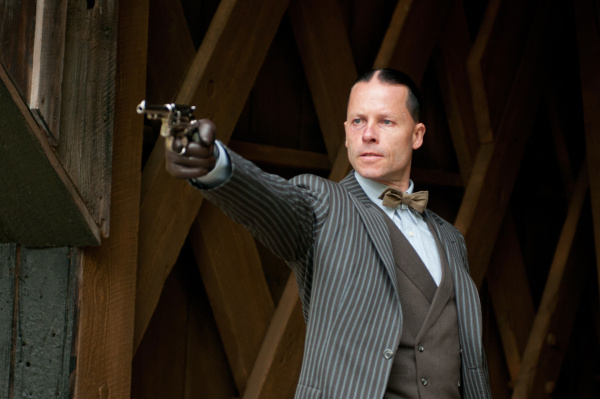
Set in 1931, Lawless focuses on the Bondurant brothers, a trio of Virginia moonshiners comprised of the taciturn Forrest (Hardy), the hard-living Howard (Jason Clarke), and the sensitive Jack (Shia LaBeouf). Thanks to Forrest and Howard, the family has become legendary as indestructible forces of nature, but, as the runt of the litter, Jack seems made of different cloth… until, well, he doesn’t.

The Bondurant’s use their gas station/diner as a front for their illegal activities, but the times are changing, and soon shady government officials are trying to force their way into getting a piece of the pie from all area moonshiners. Unlike their scared compatriots in distillery, the Bondurants resist the shakedown, drawing the ire of Charlie Rakes (Pearce), a fiendish deputy brought in from Chicago to make the locals toe the line.

Guy Pearce brings a fey creepiness to his villainous role.
It’s a great shell for a narrative, but the film is largely limited by half-baked characterizations. Jack and Forrest are the leads of the film, but they come across as pale versions of Michael Corleone and Bud White (Russell Crowe’s LA Confidential character), respectively. Both men are given love interests (Mia Wasikowska as the preacher’s daughter and Chastain as a dancer from Chicago), but the relationship are superficially drawn at best, and the actresses are largely wasted.

Nevertheless, the cast, which includes a cameo from Oldman as gangster Floyd Banner, is uniformly solid. Pearce gives the most memorable turn as the perversely grotesque Rakes, a man who greatly overestimates his ability to dominate the locals because he considers himself above their hick way of life. His scenery chewing expressly contrasts with the more measured approach of the rest of the cast, which is supposedly a stark change from the more grounded heavies in the source material, The Wettest County in the World by Matt Bondurant (Jack’s grandson).

One wishes one or two other liberties had been taken in an effort to better flesh out what plays like an awfully ordinary and telegraphed tale. As it is, this is an assured film brimming with rich atmosphere, but, unfortunately, it’s not much more than that. B-

Sunday, March 3, 2013

Les Misérables Fails to Garner Emotional Investment


The casts' Oscar performance was more enjoyable than the film itself.
Steve already provided a thoughtful and in-depth analysis of Les MisĂ©rables, so I’m going to cut straight to the point with my assessment. I found the film to be the weakest of the 2012’s Best Picture contenders. Part of that has to do with this year’s strong slate, but, outside of that, I just wasn’t into the film, which left me pretty cold and uninterested (a major problem for a production that relies heavily on emotional investment).

To be fair, I’m not the biggest fan of the stage production anyway, so the deck was stacked against the movie. I think Les Mis has a fantastic soundtrack, and the strength of the music can make for quite an emotional rollercoaster on the stage, but as a narrative, I’ve never been all that impressed. Other than two martyrs and a hardhead, every character is woefully underdeveloped. This is especially obvious in the case of Cosette, who’s nothing more than a plot device despite being the connecting tissue that binds most of the major characters together. In other words, she’s basically the human equivalent of a macguffin in an Indiana Jones film.

Getting back to the film itself, director Tom Hooper is a major part of the problem. Although I admire his decision to have the actors do all the singing live on set (a call that led to a well-deserved sound mixing Oscar), his cutting of the film is almost nonsensical at times, especially during the first hour or so. He makes the interesting choice to use extended close-ups during solos, but more often than not, that results in the whole affair seeming small when what he’s really going for is intimate (if that makes any sense).

Samantha Barks and her distractingly tight corset.
All of the actors do decent jobs with what their given. Hugh Jackman does most of the heavy lifting in this thing, and he’s solid throughout and has a great voice, so his Oscar nomination was hard won. And Anne Hathaway is fully-committed in the role that won her an Oscar. It’s essentially a one-note performance, and I wasn’t nearly as moved by the portrayal as many critics were, but girl’s a good actress and she sings pretty well, so that’s that.

Meanwhile, despite the plethora of criticism I’ve heard, I found Russell Crowe to be pretty good. Hooper does the man no favors with the way his exit scene was cut and staged, but Crowe lends a sense of gravitas to a relentless role that can get pretty frustrating for viewers at times. As for his singing voice – it’s not all that bad. He’s clearly not a match for his cast mates, but it’s not like he pulls a Pierce Brosnan in Mamma Mia. He carries the tune well enough, and his voice has a unique quality to it that contrasts nicely with the rest of the cast.

Oddly enough, I thought the film came across as a powerhouse during the Oscar ceremony itself. The clip reel they cut to showcase it was expertly edited, and the entire cast performed a fantastic medley on stage. If I hadn’t seen the movie already, I would’ve have been tricked into thinking this was a truly great movie musical. But regrettably, the spark from that telecast is not in the actual film. C+

Thursday, February 28, 2013

Life of Pi Proves a Thought-Provoking and Majestic Cinematic Experience

In addition to an emotional wallop, Life of Pi offers a feast for the eyes
that really takes advantage of 3D effects.
One of the biggest moments of Sunday’s Oscar telecast was Ben Affleck’s vindicating win for Best Picture, particularly in lieu of the fact that he wasn’t even eligible in the director category despite raking in nearly every other director award this season.  
It’s likely that Affleck would’ve won for directing if he’d been nominated, but, since he wasn’t, Ang Lee netted his second Academy Award for Life of Pi. Regardless of Affleck’s nomination status, I believe the right guy walked away with the Best Director Oscar Sunday night.
Simply put, I thought Life of Pi, which has actually become a surprising smash hit with worldwide grosses exceeding $580 million thus far, was the best movie of 2012 (more on that in a minute). However, even for those who were cold on the film’s framing device or its late breaking twist, it would be hard to deny the directorial achievement.
Yann Martel’s award-winning novel was always going to be a tough story to translate into film, and that proved true over its decade-long development, as a varying number of directors, including M. Night Shyamalan, Alfonso CuarĂłn and Jean-Pierre Jeunet, continuously failed to crack the nut. Finally, Lee took hold of the story, bringing unparalleled visual scope (aided by ace Oscar-winning VFX work*) and instilling a great deal of heart to the undertaking.
*The VFX work here by Rhythm & Hues Studio is truly remarkable, and their Oscar win this week must’ve been bitter sweet, as they recently claimed bankruptcy. HitFix’s Drew McWeeny posted a very interesting op-ed concerning the future of the VFX industry that’s worth a look for those interested.  Long story short, VFX companies have become the lifeblood of modern filmmaking and yet they are struggling to stay out of the red due to the greedy studios in Hollywood.
The central narrative is actually a story within a story. The framing device involves a writer (Rafe Spall) who visits Pi Patel (Irrfan Khan), a man who has embraced all religious outlooks since youth and somehow manages to practice all of them. The writer has come to hear Pi’s story, as he has been told it is one that will make him believe in God.

Among four Oscar wins, Life of Pi netted a much deserved
trophy for cinematography.

Patel dives into a tale about growing up in India on a zoo that his father owned and operated. In an effort to escape the turbulent political atmosphere in India, Pi’s father ultimately decides to sell off the animals and move the family to Montreal, so he contracts a Japanese ship to transport his family and the animals to Canada. A disaster occurs, and the boat sinks, but the young Pi (Suraj Sharma) manages his way into a lifeboat, ultimately turning up on the shores of Mexico 227 days later.
Spoiler Alert
Those are the definite facts.  Everything else in the movie is eventually left up to interpretation. From there, Pi tells a fantastical story about being stuck on a lifeboat with a friendly orangutan, a dastardly hyena, an injured zebra, and a Bengal tiger named Richard Parker. Pi watches on in horror as the hyena kills both the zebra and orangutan before then being killed by the tiger. Somehow, Pi manages to coexist (and even bond) with Richard Parker. Eventually, the duo spends time on an intimidating carnivorous island before drifting to Mexico where Richard Parker takes off, never to be seen again.
When found, Pi is placed in a hospital where two officials from the Japanese Ministry of Travel visit him to discuss what happened at sea. After they brush off his initial story as too farfetched to be believed, he tells them another more disturbing version of the events. In this second story, Pi says he was not joined by animals in the life boat, but rather three other human survivors – his mother, the ship’s loathsome cook and an injured sailor. Worried about limited supplies, the cook kills the sailor and later eats the man. Eventually, the cook also kills Pi’s mother, causing Pi to enact revenge and murder the cook.**
**Despite casting Gérard Depardieu as the cook, Lee does not show this variation of the story. Instead, he wisely keeps the camera on Sharma as he tells the story, making it an even more powerful and devastating version of events. Sharma is great throughout the film, but the newcomer is particularly revelatory in this scene.
The writer points out the striking similarities between the tales, noting that the orangutan is Pi’s mother, the zebra is the sailor, the hyena is the cook, and Richard Parker is Pi. Pi asks the writer which story he prefers, and the writer responds by saying he prefers the story with Richard Parker, to which Pi responds “and so it goes with God.”
The story can be interpreted in many ways. The easy conclusion is that Pi, unable to face the horror of what really happened, created a fictionalized account to retain his sanity. If that is the truth, it’s still a powerful story about how this very religious man managed to deal with horror of witnessing cannibalism and the harsh reality of being a murderer. However, it’s also possible that it all did happen and Pi was just angrily telling the Japanese officials the story they wanted to hear, or, in his words, “a story they already know.”
Real or not, Richard Parker is a marvel of VFX artistry.
In the end, it doesn’t matter which story is true. The greater question is which story do you prefer – the depressing one that makes logical sense or the miraculous one that requires suspension of disbelief? In the choice between hopeless certainty and uplifting ambiguity, the writer chooses the latter (as do the Japanese officials), and so Pi’s story becomes a tale that convinces man to believe in the unbelievable. In other words, it gives reason to “go with God.”
All of this is far more eloquently and elaborately explored in a fantastic piece by Ben Kendrick over at Screen Rant. I highly recommend checking out the article, which did wonders to illuminate the film for me. Upon exiting the theater, I knew I had seen something great, but after reading Kendrick’s words, it clarified it all for me, proving I’d seen something extraordinary.
Life of Pi is a beautiful film that works on quite a number of levels. It provides boundary-pushing visual splendors, while inviting self reflection and spirited dialogue in its macro exploration of the value of faith. However, on the micro level, it also gives us a tremendously emotional story, made all the more potent by excellent performances from Khan and Sharma, soulful direction by Lee and otherworldly VFX work that turns Richard Parker into a living, breathing character. A+

Thursday, February 21, 2013

Anderson and Tarantino Embrace Their Quirks to Great Effect with Moonrise Kingdom and Django Unchained

Wes Anderson (left) and Quentin Tarantino (right) are two of Hollywood's
half-dozen or so auteurs under 50.
It’s odd to say because of how vastly different their output is, but it occurred to me recently that Wes Anderson and Quentin Tarantino have had eerily similar career archs.
If you count the Kill Bill saga as one film, both writer/directors have made seven full-length features that have defined them as modern day auteurs with idiosyncratic approaches that countless filmmakers have unsuccessfully tried to emulate.
Both emerged with ’90s indies and gained increasing acceptance through their first three films before backlash hit in the middle of their oeuvres. Many critics and fans took issue with the likes of Kill Bill Vol. 1 & 2, Death Proof, The Life Aquatic with Steve Zissou, and The Darjeeling Limited, basically inferring they were derivative “style over substance” trifles, while decrying each man for growing stagnant in their all-consuming quirks.
Interestingly, both Anderson and Tarantino reclaimed critical adoration by releasing films in 2009 and 2012 that were, in many ways, the most Andersony and Tarintinoesque movies of their careers. Somehow two filmmakers that were criticized for working within defined wheelhouses were able to rewrite the narratives around their careers by going even further down their own stylistic rabbit holes.
 
Let’s start with Anderson. For a long time, he has been criticized for his meticulously detailed almost dollhouse-like mis-en-scene, twee sensibilities, use of slow motion, and deadpan dialogue, as well as a supposedly increasing inertness and lack of emotionality. I’ve always thought these were odd criticisms – I never could grasp why people so detested the idea of a filmmaker creating his own visual identity, and always thought that Anderson did a wonderful job of crafting wonderfully emotive and cathartic moments strikingly set against artifice. 

Moonrise Kingdom features slow-mo walking. Duh.
 Nevertheless, the complaints existed, and many people had begun to tune Anderson out as a significant purveyor of American cinema. Then, somehow, the man got back into the good graces of many and landed his second Oscar nomination for The Fantastic Mr. Fox, a film brimming with deadpan quirk and featuring costumes and set design so detailed that the they are almost otherworldly (and, in fact, they are literally slavishly rendered doll clothing and dollhouses).
Anderson has followed that success with Moonrise Kingdom, a film that garnered him another Oscar nomination and that many have called the best of his career, despite the fact that it contains all of the same Anderson eccentricities and ups the twee to even higher levels.
 Although I prefer several other Anderson titles, I found Moonrise Kingdom to be a great little film, choke full of richly thematic undertones involving first love, destiny, abandonment, and the need to be, if not understood, than accepted. The film focuses on two 12-year-olds – Sam (Jared Gillman), a resourceful orphan Khaki scout, and Suzy (Kara Hayward), the mostly ignored black sheep child of two checked out lawyer parents – who decide to run away together after courting via a series of letters.
Anderson nails the uncertainly, exhilaration and sensitivity of navigating love for the first time. Sam and Suzy know what their supposed to do and awkwardly go through the romantic motions, but what really forges their bond is a refreshing and needed dose of head-on openness.
Importantly, Gillman and Hayward are inherently interesting and natural performers, and the absurdity that these kids decide to run away together on an island is part of the charm. So too is the contrasting lack of purpose present in all the adult characters (Edward Norton as a scout leader, Bruce Willis as a local sheriff, and Bill Murray and Frances McDormand as Suzy’s parents), although, other than Willis, I’d say they are largely wasted.

The chemistry between Christoph Waltz and Jamie Foxx is
the heart of Django Unchained.
Tarantino has operated on a larger scope than Anderson, making larger, more popular movies, while having already landed an Oscar for writing Pulp Fiction. However, backlash for his incessant concentration on ironic violence, endless bouts of verbal dexterity, use of fake brands, and employment of eye-popping angles and zooms, as well as his penchant for fawning riffs on genre movies seemed to reach a boiling point with the release of Death Proof.
And yet he reemerged in a big way three years ago when Inglorious Basterds – an alternate take on WWII that plays up the revenge-tinged violence and indulges Tarantino’s love for stylistic embellishment and long, immersive dialogue scenes – dominated at the box-office and grabbed eighth Oscar nominations (including best director and screenplay). 
This year he’s repeated the trick with Django Unchained, another genre exercise revenge story mash up. This time, the director combines spaghetti westerns and blaxploitation in an examination of slavery. Although that seems a dicey prospect, the film has become Tarantino’s highest grossing film and nabbed five Oscar nominations to boot (including another writing nod for him).
The entire film is conceived with a wink and a nudge, even more so than Inglorious Basterds, which felt more realistic in a way, despite the fact that it was rewriting known history while this story is at least probable. The film is often comedic in the way it’s shot, scripted and acted, and although it contains tracks from Ennio Morricone the legendary composer of Sergio Leone's Dollars trilogy, most of the soundtrack is composed of funkified originals and classic pop tunes. 

The film focuses on Dr. King Schultz (Christoph Waltz), a dentist-turned-bounty hunter who buys a slave named Django (Jamie Foxx) to help him locate and take out several marks. In return Schultz offers Django his freedom and agrees to help him save his enslaved wife Broomhilda (Kerry Washington) from Candie Land, a plantation lorded over by the maniacal Calvin Candie (Leonardo DiCaprio) and run by treacherous house slave Stephen (Samuel L. Jackson).

Waltz steals the picture outright with a role that was likely written in direct response to his head-turning turn in Basterds. I imagine Quentin so loved Waltz’s take that he was inspired to convert the archetype into a good guy and get back in the sandbox with him. Schultz is the same type of pragmatic and dangerous charmer as Hans Landa, except he’s layered with a level of humanity and compassion that none of the hardened Americans in the piece seem to possess.
DiCaprio and Jackson also are afforded larger-than-life characters and they more than make their mark in transformative roles, despite being absent for the first two-thirds of the film. DiCaprio shows a different, more flamboyant side of his range, while Jackson manages to keep Waltz at bay for the title of greatest Tarantino collaborator based on the sheer diversity of their collaborations alone. 
By design, Foxx is given less to work with, as Django is rejiggered version of the badass of few words made famous by western luminaries like Clint Eastwood. He’s solid and projects the right amount of attitude, but it’s hard to deny that the life begins seeping out of the film once Schultz is out of the picture and Django takes center stage. A lot of that has to do with the minimal amount of investment put into his relationship with Broomhilda. She barely registers as more than a plot device, and the heart of the film is the bromance between Schultz and Django (Foxx’s delivery of expertly set up “Auf Wiedersehen” is a sweet coda to the relationship).
I greatly enjoyed the tone and pulpy aspects of Django but I felt it didn’t have half the momentum or development of Inglorious Basterds, and so it plays like a lesser version of a similar movie. That said, there’s so much to like here that it hardly matters it fails to reach such lofty heights.
Overall, I’m glad to see both Anderson and Tarantino back on top. I never understood the backlash against them, because I couldn’t imagine why anyone would want these men to make films that weren’t personal and drenched in their own eccentricities. While I admire filmmakers like Ron Howard who are almost invisible in their ability to craft diverse, four-quadrant movies with minimal overlapping distinctiveness, I don’t think we should be forcing specialists like Anderson and Tarantino to stifle their artistic identifies. To me, it’d be like forcing Picasso or Salvador Dahli to paint classical art – an utter waste of individuality and talent.
Fortunately, that’s not the case with these two great filmmakers. Moonrise Kingdom A-, Django Unchained B+