The one thing I disliked most about doing musical theater
in high school was the fact that people’s opinions about certain shows –
especially the more popular ones – were usually so biased or so stacked in the
favor of professional versions they had seen or their original Broadway cast
album that our paltry pubescent performances seemed like a kindergarten play.
Of course, opinions about movies can also go in a similar direction.
So, obviously, this was the first thing I thought about
as I was watching Les Misérables in
the theater. I’ve purposely avoided reviews of the movie not originating from
top film critics because Les Misérables
is one of those shows that so many people feel some sort of personal
relationship with, for some reason or another. As a result, I imagine most
people familiar with the show will or have had difficulty viewing the movie
objectively. In other words, for a theater diehard, this movie is probably a
cruel mixture of a wet dream and terrible nightmare realized.
Trying to be objective as possible,* I thought the movie
was a well-conceptualized, well-cast, well-shot and well-adapted musical
movie. Instead of simply taking the most beloved musical of all time by
every woman a well-known musical and shooting it with a camera, director
Tom Hooper makes what feels like an original movie. Of course, anybody who is
remotely familiar with the show, or simply the music, will know the whole
thing. However, the brilliance of what Hooper does is he makes the movie easily
digestible for those not familiar with it and gives the diehards enough
nostalgia to hug and enough new and interesting material to chew on.
What Hooper does for those not familiar with the show is
he rearranges the order of some of the songs, changes occasional lyrics and
injects some extra wording so that Les
Mis newbies know exactly what the heck is going on. One example is changing
around some of the lyrics so that the audience knows who General Lamarque is
and why his death is important to the student rebels (it drives them to fight).
Another is injecting the name of Enjolras, the rebel leader, more than it
appears in the play – once or twice max, which I always thought was weird for
one of the story’s most influential characters. Additionally, the movie is
played as a movie, filled with beautiful cinematography and not just an
opportunity to shoot singing soliloquies, which I am assuming many fans of the
musical might expect.
For the Les Mis fans
out there, it stays faithful to the musical in that it only eliminates two
not-entirely-necessary songs in “Dog Eats Dog” and “I Saw Him Once,” only cuts
the lyrical fat when it makes sense (e.g. Gavroche’s “Little People,” a song
that sounds so anachronistic to the feel of the movie and the emotion of the
scenes surrounding it that cutting out most of it seems like a blessing). In
terms of bringing in something original, the song “Suddenly” fits in well to
the tone, although its sound is a little different from the rest of the score,
and helps to strengthen the audience’s understanding of where Jean Valjean is
emotionally at the point in the film when he buys Cosette from the Thernadiers
to raise her as his own. The movie also brings back stars from the original
theater productions in smaller roles, such as Valjean-originator Colm Wilkinson
as the bishop.
And, of course, my favorite part of the movie that I
think helps to draw in both newbies and fans alike is the fact that (most, I
assume, and not all) vocals were recorded live on set as opposed to being
recorded previously and receiving the lip synch treatment. Fans can appreciate
the “live,” non-produced quality of the singing while unfamiliar moviegoers can
view it as a movie with calculated acting decisions and emotional heart
stitched within every note. This isn’t the first musical movie to ever utilize
this post-talkies, but it’s definitely the most high-profile and one that makes
amazing use of it.
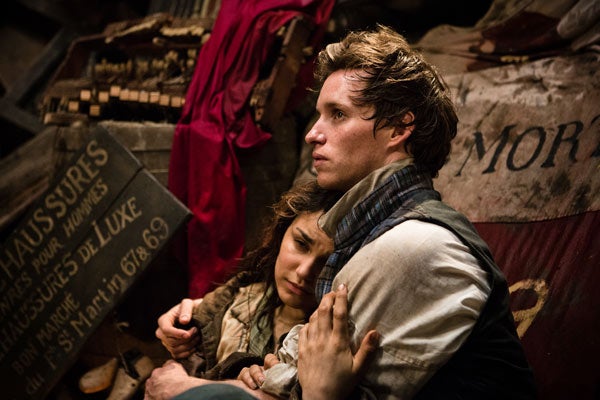 |
If this were Taylor Swift being held, the internet would have
stormed so many barricades and brought this film to its knees.
|
Les Misérables deserves most of the accolades it has received, and that is without even
touching upon individual acting and singing performances. When the movie was in
the midst of casting decisions, fans filled the internet with angry words about
their thoughts on Anne Hathaway and Fantine and seemingly pubescent uproar
about the possibilities of Taylor Swift and other well-know actresses possibly
being cast as Eponine, the girl every woman ever high school girl thinks
defines her.
However, in my humble (and probably incorrect) opinion,
this movie truly benefits – in some way or another – from the casting of each
of the main characters. And, yes, that includes Russell Crowe, too, angry
internet people.
Although you could argue that the musical itself features
an ensemble of characters, the story is essentially the story of Jean Valjean,
a prisoner jailed for stealing bread for his sister’s family, who eventually
breaks parole in an attempt to change his life for the good of himself and
others and stop living with the anger against the world that he believes has
done him wrong all these years. It his emotional journey that lays the foundation
for the entire story. And it is Hugh Jackman’s ability to harness that emotion,
tie that into every lyric he sings, sing it well and give the audience the
opportunity to see such a distinctive, remarkable change in such an amazing
character that lays the foundation for the rest of the actors’ performances.
Jackman, a Tony winner, is obviously a skilled singer and
displays his range prominently. Even his rendition of “Bring Him Home,” a
reflective song that serves as a pause during the action-packed battle
sequences and challenges the actor to spend a lengthy amount of time in the
higher registers, sounds appropriate coming from his mouth.
|
|
Calm down, internet. He's not that bad.
|
As an actor, he meets his match in Russell Crowe, who has the brooding down to a science with his characterization of Javert. Now Crowe has been getting a lot of flak for his singing in this movie. It is obvious he doesn’t have the same singing chops as most of the other actors. However, he’s not really all that bad of a singer (see here for a pretty good defense). He hits all the notes after all. The problem is he can’t hold all the notes, and he’s not on the superior level one would assume from an actor cast in the movie version of Les Misérables.Here’s why it doesn’t bother me though. I’ve heard
renditions of the character where Javert’s songs are almost talk-sung. Of
course, this is not really the case with the solo numbers “Stars” and “Javert’s
Suicide.” All in all, Crowe did best when his singing could be blended into his
excellent acting, such as during “The Confrontation.”
Anne Hathaway is adequate as Fantine – nothing
out-of-this-world amazing but also pretty good at the same time. I’ve heard a
few criticisms saying she doesn’t really sing “I Dreamed a Dream,” that she
more breathily pants the words. A lot of that has to do with the live-on-set
singing. But Hathaway is also playing a broken person, a woman whose life is
being quickly destroyed as she tries to do everything she can to make sure her
daughter’s life does not follow the same path. Similarly, Amanda Seyfried does
well as Cosette, acting and singing well in the limited screen time she has.
 |
No, every girl in the world. You are not Eponine. Samantha
Barks is, and she's pretty fantastic in this movie.
|
The female standout, in my mind, is Samantha Barks as
Eponine. The smartest thing the people behind this movie did was cast her in
the role that – along with possibly Fantine – was going to be the most scrutinized,
a role that almost caused the internet to shut down when it was rumored that
Taylor Swift might be inhabiting it. Barks brings a likable and subtle
freshness that makes her friendship with Marius believable and sings with an
innocent sweetness that helps the audience empathize with her and make the
emotions Barks displays seem genuine.
Eddie Redmayne and Aaron Tveit are both very good as
Marius and Enjolras, respectively. Redmayne is definitely a good singer with an
operatic voice and a boyish charm. His handling of “Empty Chairs at Empty
Tables” is impeccable, aided by the static camera and the choice to focus on
the emptiness of the café room. And the role of Enjolras is a powerful but
ultimately thankless role – partially due to the lack of name recognition
throughout the play – that Tveit ably powerhouses.
As the Thernadiers, Sacha Baron Cohen and Helena Bonham
Carter (or Tom Hooper or a combination of the two) made the decision to play
the innkeepers in a way that mixes the lighthearted comedy of the roles with
their dark ruthlessness and indifference toward humanity. What was most
enjoyable was the affection the two characters showed for each other; in many
renditions of the play, they are often portrayed as reluctant comrades. In the
movie, they do their misdeeds literally with a wink and a nod.
 |
Colm Wilkinson has always looked like an elderly clergyman. He's finally
won the role of his lifetime. Hugh Jackman, eat your heart out.
|
My favorite casting of the whole movie, though, is Colm
Wilkinson, the original Jean Valjean on the West End and Broadway, as the
Bishop of Digne. Wilkinson’s voice has always had an older and patriarchal tone
to it. That tone worked well for Valjean all those years ago but is spot on for
the bishop in this movie. Wilkinson’s acting and singing are both solid. And in
both a nod to his – that is, both Wilkinson and the Bishop of Digne character –
importance to the evolution of the telling of Les Misérables and a brilliant directorial decision, we see Valjean
spiritually comforted by both Fantine and the bishop, instead of the
Fantine-and-Eponine duo seen in the play.
A few additional notes:
Anybody familiar with the play was probably expecting to see the rebels’ barricade as a huge mountain, as it is depicted in the musical, stationed upon a rotating stage. In this movie, however, the students have only built a small hill of furniture and various wares they have found in the neighboring buildings. I really liked this for the reality of it all. When it comes down to it, these kids were…kids, students whose opinions did not permeate beyond their own heads. They were small in number, didn’t have a huge army and didn’t have a lot of time (or engineering and architectural know-how) to build a monster of a barricade. And I thought it greatly captured that they were isolated in their attempts to revolt, ignored and left to die by the rest of the citizens.
Accents. It’s always funny to me that whenever an English-speaking movie takes place in a foreign-language country, the base accent used is always British. Of course, Australians Hugh Jackman and Russell Crowe and Irish Colm Wilkinson keep their respective accents. But Americans Anne Hathaway and Amanda Seyfried switched over to Bristish singing accents for this movie. This isn’t a criticism, but more of an amused observation.
One thing I’ve noticed in hearing the soundtrack played during award shows or via audio clips is that one really needs to be watching the film to truly appreciate the quality of the singing. Due to the live, on-set singing, the singing isn’t as polished or produced. In a way, that might stop people from purchasing the soundtrack. But it also, in my mind, helps to bolster the quality of the acting performances and the singing, combined as they were meant to be.
*I actually was in Les
Misérables in high school right when they
first released the rights for schools to perform it (I was Marius). My school
was one of, I believe, the first 10 schools to get the rights. As a result of
the familiarity, I’ve always appreciated the show. I’ve also seen it performed
on the West End and on national tour. I’ve also read (most of) the source
material by Victor Hugo.


